
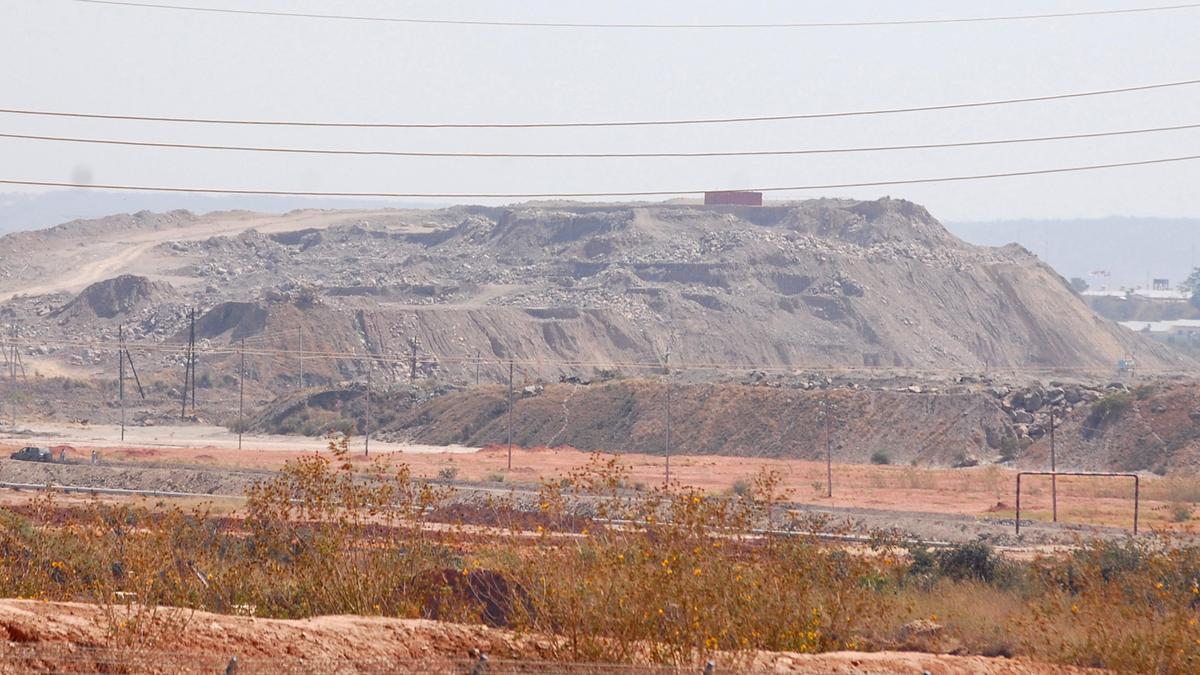
The moon is a key step in the journey of space exploration, but making it habitable brings up lots of questions around space law and policy.
Pop icon Katy Perry joined five other civilian women on a quick jaunt to the edge of space, making headlines. Meanwhile, another group of people at the United Nations was contemplating a critical issue for the future of space exploration: the discovery, extraction and utilization of natural resources on the moon.
At the end of April, a dedicated Working Group of the United Nations Committee on the Peaceful Uses of Outer Space released a draft set of recommended principles for space resource activities. Essentially, these are rules to govern mining on the moon, asteroids and elsewhere in space for elements that are rare here on Earth.
As a space lawyer and co-founder of For All Moonkind, a nonprofit dedicated to protecting human heritage in outer space, I know that the moon could be the proving ground for humanity’s evolution into a species that lives and thrives on more than one planet. However, this new frontier raises complex legal questions.
Space, legally
Outer space – including the moon – from a legal perspective, is a unique domain without direct terrestrial equivalent. It is not, like the high seas, the “common heritage of humankind,” nor is it an area, like Antarctica, where commercial mining is prohibited.
Instead, the 1967 Outer Space Treaty – signed by more than 115 nations, including China, Russia and the United States – establishes that the exploration and use of space are the “province of all humankind.” That means no country may claim territory in outer space, and all have the right to access all areas of the moon and other celestial bodies freely.
The fact that, pursuant to Article II of the treaty, a country cannot claim territory in outer space, known as the nonappropriation principle, suggests to some that property ownership in space is forbidden.
Can this be true? If your grandchildren move to Mars, will they never own a home? How can a company protect its investment in a lunar mine if it must be freely accessible by all? What happens, as it inevitably will, when two rovers race to a particular area on the lunar surface known to host valuable water ice? Does the winner take all?
As it turns out, the Outer Space Treaty does offer some wiggle room. Article IX requires countries to show “due regard” for the corresponding interests of others. It is a legally vague standard, although the Permanent Court of Arbitration has suggested that due regard means simply paying attention to what’s reasonable under the circumstances.
First mover advantage – it’s a race
The treaty’s broad language encourages a race to the moon. The first entity to any spot will have a unilateral opportunity to determine what’s legally “reasonable.” For example, creating an overly large buffer zone around equipment might be justified to mitigate potential damage from lunar dust.
On top of that, Article XII of the Outer Space Treaty assumes that there will be installations, like bases or mining operations, on the moon. Contrary to the free access principle, the treaty suggests that access to these may be blocked unless the owner grants permission to enter.
Both of these paths within the treaty would allow the first person to make it to their desired spot on the moon to keep others out. The U.N. principles in their current form don’t address these loopholes.
The draft U.N. principles released in April mirror, and are confined by, the language of the Outer Space Treaty. This tension between free access and the need to protect – most easily by forbidding access – remains unresolved. And the clock is ticking.
The moon’s vulnerable legacy
The U.S. Artemis program aims to return humans to the moon by 2028, China has plans for human return by 2030, and in the intervening years, more than 100 robotic missions are planned by countries and private industry alike. For the most part, these missions are all headed to the same sweet spot: the lunar south pole. Here, peaks of eternal light and deep craters containing water ice promise the best mining, science and research opportunities.
In this excitement, it’s easy to forget that humans already have a deep history of lunar exploration. Scattered on the lunar surface are artifacts displaying humanity’s technological progress.
After centuries of gazing at our closest celestial neighbor with fascination, in 1959 the Soviet spacecraft, Luna 2, became the first human-made object to impact another celestial body. Ten years later, two humans, Neil Armstrong and Buzz Aldrin, became the first ever to set foot upon another celestial body.
More recently, in 2019, China’s Chang’e 4 achieved the first soft landing on the moon’s far side. And in 2023, India’s Chandrayaan-3 became the first to land successfully near the lunar south pole.
These sites memorialize humanity’s baby steps off our home planet and easily meet the United Nations definition of terrestrial heritage, as they are so “exceptional as to transcend national boundaries and to be of common importance for present and future generations of all humanity.”
The international community works to protect such sites on Earth, but those protection protocols do not extend to outer space.
The more than 115 other sites on the Moon that bear evidence of human activity are frozen in time without degradation from weather, animal or human activity. But this could change. A single errant spacecraft or rover could kick up abrasive lunar dust, erasing bootprints or damaging artifacts.
Protection and the Outer Space Treaty
In 2011, NASA recommended establishing buffer, or safety zones, of up to 1.2 miles (2 kilometers) to protect certain sites with U.S. artifacts.
Because it understood that outright exclusion violates the Outer Space Treaty, NASA issued these recommendations as voluntary guidelines. Nevertheless, the safety zone concept, essentially managing access to and activities around specific areas, could be a practical tool for protecting heritage sites. They could act as a starting point to find a balance between protection and access.
One hundred and ninety-six nations have agreed, through the 1972 World Heritage Convention, on the importance of recognizing and protecting cultural heritage of universal value found here on Earth.
Building on this agreement, the international community could require specific access protocols — such as a permitting process, activity restrictions, shared access rules, monitoring and other controls — for heritage sites on the Moon. If accepted, these protective measures for heritage sites could also work as a template for scientific and operational sites. This would create a consistent framework that avoids the perception of claiming territory.
At this time, the draft U.N. principles released in April 2025 do not directly address the opposing concepts of access and protection. Instead, they defer to Article I of the Outer Space Treaty and reaffirm that everyone has free access to all areas of the Moon and other celestial bodies.
As more countries and companies compete to reach the Moon, a clear lunar legal framework can guide them to avoid conflicts and preserve historical sites. The draft U.N. principles show that the international community is ready to explore what this framework could look like.